

- 1. The Invisible Service Anchor in Shoe Retail
- 2. Why Stability Defines the Trial Experience
- 3. Comfort That Shortens Decision Hesitation
- 4. Storage Logic That Organizes Every Square Meter
- 5. Material Choices That Withstand Daily Intensity
- 6. Matching the Fixture to Store Formats
- 7. Customization and Brand Memory
- 8. Frequently Asked Questions
Walking into a shoe store, most customers notice the lighting, the window display, or the latest collection. Very few consciously register the seat they lower themselves onto before trying a pair. Yet that brief moment—the transition from browsing to fitting—carries disproportionate weight in how the visit feels. A wobbly stool creates hesitation; a cramped bench breeds frustration; a cluttered fitting corner signals neglect. The Shoe-Trying Stool enters this overlooked space not as decoration, but as a quiet infrastructure piece that determines whether the trial stage feels effortless or awkward.
1. The Invisible Service Anchor in Shoe Retail
Retail environments are composed of visible persuasion—signage, product placement, staff greetings—and invisible persuasion. The latter includes sightlines, walking paths, and the physical comfort of transitional moments. Fitting furniture belongs to this second category. When a customer decides to try a shoe, they are momentarily vulnerable: one foot is lifted, balance shifts, and attention splinters between the product and their own stability. A poorly designed seat turns this moment into a minor physical negotiation. A well-designed one removes the negotiation entirely.
The engineering approach behind this fixture treats it as a service anchor rather than a furniture afterthought. The frame and seat height are calibrated not only for sitting, but for the specific biomechanics of shoe fitting—one knee bent, torso leaning forward, hands reaching toward a buckle or lace. Every measurement is tied to that posture. In this sense, the fixture stops being passive inventory and becomes part of the store's operational logic.
From background object to frontline tool
Most store furniture is expected to stay out of the way. The fitting stool is different. It is actively used dozens of times per day, bearing shifting weight and facilitating a service interaction. Treating it as frontline equipment—rather than backroom furniture—changes how it is specified, maintained, and positioned within the sales floor. Store planners who recognize this shift begin to allocate prime floor space to the trial zone, knowing that the seat is where the purchase decision actually crystallizes.
Consider the sequence of a typical trial. A customer selects a size, sits down, removes a shoe, reaches for the new pair, inserts a foot, stands up, checks the fit in a mirror, sits back down, and repeats. Each transition depends on the seat's stability and the proximity of storage. If the stool wobbles or the shoe boxes are out of reach, the sequence breaks. Staff must intervene, the customer's focus drifts, and the trial becomes a chore rather than a discovery. The fitting stool, when properly specified, keeps that sequence intact and invisible.
2. Why Stability Defines the Trial Experience
Balance is the first physical challenge of trying on shoes. Customers frequently test a shoe while standing on one leg, leaning forward to check the heel or adjust a strap. If the seat beneath them creeps, tilts, or rocks, the body instinctively tightens. That tension distracts from the product. The Shoe-Trying Stool addresses this through a triangular mechanical structure supported by a 1.2 mm thickened cold-rolled steel frame and a high-density solid wood base plate, achieving an overall load capacity of 150 kg.
This figure matters less as a number and more as a behavioral threshold. When a customer senses that the seat will not shift under lateral weight transfer, they stop thinking about the furniture and start thinking about the shoe. The trial becomes product-focused. Traditional stools that sway or tip over create a low-grade vigilance that subtly shortens the trial duration. Stability, in other words, is not merely a safety feature—it is a cognitive enabler.
- Triangular load distribution keeps the center of gravity predictable during one-foot weight shifts.
- Thickened steel and solid wood resist flexing under repeated daily use.
- Rounded frame edges are hand-polished three times, eliminating sharp contact points.
- The 45 cm seat height matches Asian leg proportions, allowing a natural 90° knee bend without overreaching.
For elderly customers and children, this stability translates into accessibility. A lower or unstable seat forces compensatory movements that can feel unsafe. A correctly proportioned, rigid platform lets them sit and rise with less assistance, which reduces staff intervention and shortens the fitting cycle. In family shoe stores, this means parents can focus on their own choices while children safely manage their own trials.
Testing the limits of lateral movement
When a customer crosses one leg over the other to tie a lace, the seat experiences a lateral force that many lightweight stools cannot handle. The triangular bracing under the seat distributes this force across three anchor points, preventing the tipping motion that occurs when weight shifts beyond the front edge. This is why the stool remains planted even when the user leans forward to inspect a toe box or reaches sideways for a second pair.
3. Comfort That Shortens Decision Hesitation
Comfort during shoe fitting is not a luxury—it is a decision variable. A customer who feels a pressure point from the seat cushion will transfer that sensation onto the product, often without realizing it. The 6 cm high-resilience memory foam used in the seat counteracts this by distributing pressure across the sitting surface rather than concentrating it at the ischial tuberosities. The breathable, wear-resistant fabric cover prevents the stuffiness that long trial sessions can produce.
The practical effect is that customers are willing to sit longer, compare more pairs, and re-try options they might otherwise dismiss. Each additional minute of comfortable trial increases the likelihood that a shoe is evaluated on its actual fit rather than on the fatigue of the fitting process. This is where the fixture contributes indirectly to conversion: not through persuasion, but through the removal of discomfort as a competing stimulus.
Details that customers feel but do not articulate
Three rounds of hand-polished edge treatment eliminate the sharp corners that catch calves and ankles when customers twist to reach shoe boxes. The seat surface remains level and supportive rather than sloping backward, which helps older customers rise without pushing against a soft, collapsing edge. These are not features that appear on a showroom floor plan, but they shape the physical memory of the visit.
Another subtle factor is the seat's thermal behavior. Breathable fabric allows air to circulate, preventing the clammy sensation that vinyl or non-breathable covers create during longer trials. When a customer tries on multiple pairs in a single visit—common in multi-brand stores—the seat remains comfortable from the first trial to the last. That consistency reinforces the perception of a well-run store.
4. Storage Logic That Organizes Every Square Meter
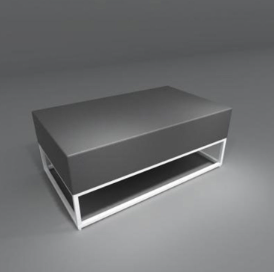
Shoe fitting areas fail not because of insufficient space, but because of unstructured space. Boxes pile up, discarded shoes scatter, and staff spend valuable seconds searching for a missing size. The integrated structure of the fitting stool addresses this by assigning every object a predictable location. A 20 cm open shoe rack beneath the seat holds 3 to 4 pairs awaiting trial, keeping them visible to both staff and customers. A side rotating metal shoe holder catches removed shoes before they end up under a bench or behind a display.
Some configurations add a pull-out storage compartment for shoe polish, shoehorns, size labels, and other small tools. The logic is consistent: consumables remain hidden from the customer's immediate sightline but accessible to staff within arm's reach. This reduces visual noise in the fitting zone and shortens the retrieval loop during busy periods.
| Storage Component | Capacity / Function | Operational Benefit |
|---|---|---|
| Open under-seat rack | 3–4 pairs awaiting trial | Keeps trial inventory visible and accessible |
| Side rotating metal holder | Removed shoes during fitting | Prevents floor clutter and misplaced pairs |
| Pull-out compartment (select models) | Polish, shoehorns, size labels | Hides small tools while keeping them reachable |
| Seat surface | Single or double occupancy | Supports individual or companion trial sessions |
The spatial consequence is significant. A single unit occupies only 0.2 m², allowing it to be embedded in narrow gaps beside shelving or within compact fitting rooms. The two-person modular version supports side-by-side placement for high-traffic periods without expanding the overall footprint. In both cases, the fixture converts dead or transitional floor area into functional service space.
Reducing cross-contamination of sizes
When trial shoes are stored on the under-seat rack rather than scattered on the floor, staff can quickly verify which sizes have been offered and which remain in the back room. This simple visibility reduces the risk of mixing up left and right pairs or sending the wrong size out with a customer. The rotating holder on the side separates removed shoes from new trial pairs, preventing the accidental packaging of a worn shoe. These small organizational habits compound over hundreds of transactions.
5. Material Choices That Withstand Daily Intensity
A shoe store fitting area is a high-contact environment. Dust, shoe polish residue, and repeated weight shifts accumulate throughout the day. The commercial-grade stain-resistant and waterproof fabric on the seat can be wiped clean with a damp cloth, maintaining its appearance even after dozens of uses. This is not a cosmetic advantage—it directly affects how customers perceive the store's hygiene and attention to detail.
The frame materials reinforce this durability logic. Cold-rolled steel resists deformation under repeated loading, while the high-density solid wood base plate distributes force without flexing or cracking. For stores that operate long hours with continuous foot traffic, these material choices reduce the frequency of replacement and maintenance interruptions. The Shoe-Trying Stool is therefore specified not only for what it does on day one, but for how it behaves after months of constant use.
- Commercial-grade fabric resists polish stains and dust accumulation.
- Cold-rolled steel frame maintains structural rigidity under repeated shifts.
- Solid wood base plate prevents warping or softening at high-contact points.
- Hand-polished edges retain their finish without chipping or sharpening over time.
Material consistency also matters across multiple units in the same store. When every fitting stool shares the same frame thickness and upholstery grade, the visual and tactile experience remains uniform from the entrance to the back of the store. Customers subconsciously register this consistency as a sign of quality control.
6. Matching the Fixture to Store Formats
No single fitting configuration suits every retail environment. A luxury boutique, a multi-brand sports floor, and a children's shoe corner each impose different spatial and aesthetic constraints. The fitting stool adapts through two structural variables: footprint and style. The single-seat model fits into fitting rooms, beside shelving, or in the narrow gap between display tables. The double-seat modular model supports paired seating for stores where families or groups shop together.
Style options—champagne gold, matte black, and custom colors—allow the fixture to align with the store's visual language. In luxury leather footwear environments, a champagne gold frame with velvet upholstery supports a premium impression. In sports and outdoor counters, the industrial profile of the steel frame matches the brand's performance orientation. For children's shoe areas, rounded corners and eco-friendly ABS components prioritize safety without sacrificing visual appeal.
| Store Format | Recommended Configuration | Primary Design Rationale |
|---|---|---|
| Luxury footwear boutique | Champagne gold frame, velvet fabric, single or double seat | Matches premium interior language |
| Sports brand counter | Matte black steel frame, commercial fabric, double seat | Durable, industrial, high-frequency ready |
| Children's shoe store | Rounded ABS elements, bright colors, single seat | Safety and approachable aesthetics |
| Multi-brand shoe floor | Mixed styles by zone, modular placement | Visual consistency across different brand areas |
Adapting to irregular floor plans
Many shoe stores inherit architectural constraints—columns, angled walls, or narrow aisles—that make standard furniture difficult to place. The modular nature of the fitting stool allows it to be rotated, split into single units, or combined into double units depending on the available geometry. A corner that previously held a clutter of boxes can become a functional trial station with two chairs and a shared storage rack.
7. Customization and Brand Memory
The seat surface can be customized with a brand logo embossed directly into the fabric. This is a subtle but persistent touchpoint: every customer who sits down is exposed to the brand mark at close range, without a promotional message competing for attention. The impression is spatial and tactile rather than verbal. Over repeated visits, the mark becomes associated with the physical comfort of the fitting experience.
Customization also extends to dimensions and combinations. Stores with irregular floor plans can adjust placement to fit alcoves, corners, or transitions between departments. The goal is not to force the fixture into a standard template, but to let the fitting zone emerge from the store's actual geometry. This flexibility makes the fitting stool a long-term spatial asset rather than a fixed piece that must be worked around.
For retail teams evaluating fitting-area upgrades, the decision ultimately comes down to whether the fixture reduces friction or adds it. A stable, comfortable, organized seat reduces the physical and cognitive effort of trying on shoes. That reduction is felt by customers as a smoother visit and by staff as a more manageable service flow. Zhongbo manufactures these fixtures with the specific demands of shoe retail in mind—steel frames, solid bases, integrated storage, and finishes that survive daily intensity.
8. Frequently Asked Questions
Can the fitting stool support customers who stand on one foot during trial?
Is the seat height suitable for both adults and children?
How much floor space does a single unit require?
Can the seat fabric be cleaned when shoe polish or dust accumulates?
Are different styles available for different store decors?
Does the storage compartment interfere with the seating area?
Contact us to discuss your store's fitting-area requirements and design a tailored configuration that matches your floor plan and brand identity.
Contact Us